
Palletizing robots
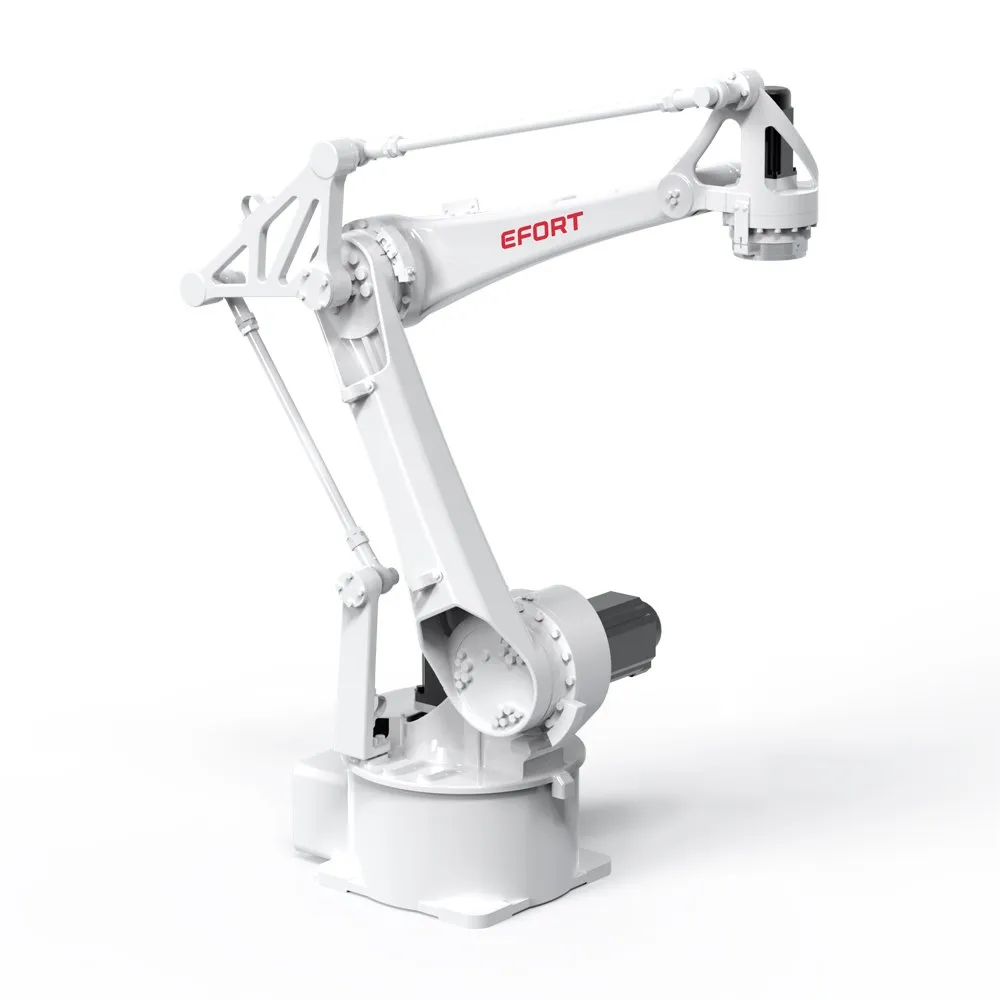
Three EFORT four-axis palletizing robots: ER15-4-1600 (15 kg, 1,625 mm), ER130-4-2800 (130 kg, 2,816 mm) and ER180-4-3200 (180 kg, 3,160 mm). Four axes keep the gripper level, which buys payload and reach for the same machine mass. We supply them with grippers, pallet handling and cell control, supplied and integrated by LIVESPOWER.
The four-axis range
| Model | Payload | Reach | Repeatability | Robot weight | Protection | Typical duty |
|---|---|---|---|---|---|---|
| ER15-4-1600 | 15 kg | 1625 mm | ±0.07 mm | 180 kg | IP54 / IP65 (wrist) | Light cases, cartons and bags on a single pallet station. |
| ER130-4-2800 | 130 kg | 2816 mm | ±0.1 mm | 970 kg | IP54 / IP65 (optional) | Bagged goods, cases and layer picking to about 1.8 m stack height with a multi-case gripper. |
| ER180-4-3200 | 180 kg | 3160 mm | ±0.1 mm | 1350 kg | IP54 / IP65 (optional) | Heavy bags, drums and full-layer palletizing, or two pallet stations served from one position. |
Values from the EFORT Robot Selection Guide 2024. Each four-axis model has a combined J2+J3 limit that defines the vertical working window — it is in the model data we send with a quotation.
When six axes are the better answer
A four-axis machine keeps the tool horizontal. If the product must be tilted, laid on its side, or placed at an angle — bagged goods into a shaped stack, cartons into a display pallet, parts into a fixture rather than onto a pallet — a six-axis robot is the right machine even though it carries less for its size. These are the heavy six-axis models we supply for that work:
| Model | Payload | Reach | Repeatability | Weight | Protection |
|---|---|---|---|---|---|
| ER50-2100 | 50 kg | 2146 mm | ±0.06 mm | 550 kg | IP54 / IP67 (wrist) |
| ER70-1900 | 70 kg | 1901 mm | ±0.06 mm | 545 kg | IP54 / IP67 (wrist) |
| ER70-2100 | 70 kg | 2146 mm | ±0.06 mm | 550 kg | IP54 / IP67 (wrist) |
| ER150-2700 | 150 kg | 2674 mm | ±0.1 mm | 1110 kg | IP65 |
| ER150-3200 | 150 kg | 3192 mm | ±0.2 mm | 1150 kg | IP65 |
| ER210-2700 | 210 kg | 2674 mm | ±0.1 mm | 1110 kg | IP65 |
The full industrial robot range →
What a palletizing cell contains
- Gripper — vacuum, clamp, fork or combination, sized to the case, bag or product and to the number picked per cycle.
- Infeed — conveyor, case turner, row former or layer former depending on the pattern.
- Pallet handling — pallet dispenser, empty and full pallet conveyors, slip-sheet and top-sheet placement.
- Safety — guarding, light curtains at the pallet exchange, muting for the pallet conveyor.
- Cell control — safety PLC, pattern management on the HMI, so new patterns do not need robot programming.
- Stretch wrapping and labelling where they are in scope.
What we ask for before quoting
- Product: dimensions, weight, packaging type and whether it is stable enough to be gripped by vacuum.
- Rate: cases or bags per minute, per line, and the number of lines the robot must serve.
- Pallet: size, pattern per layer, number of layers, maximum stack height, and whether slip sheets are used.
- Layout: infeed height and direction, pallet station positions, and the space available.
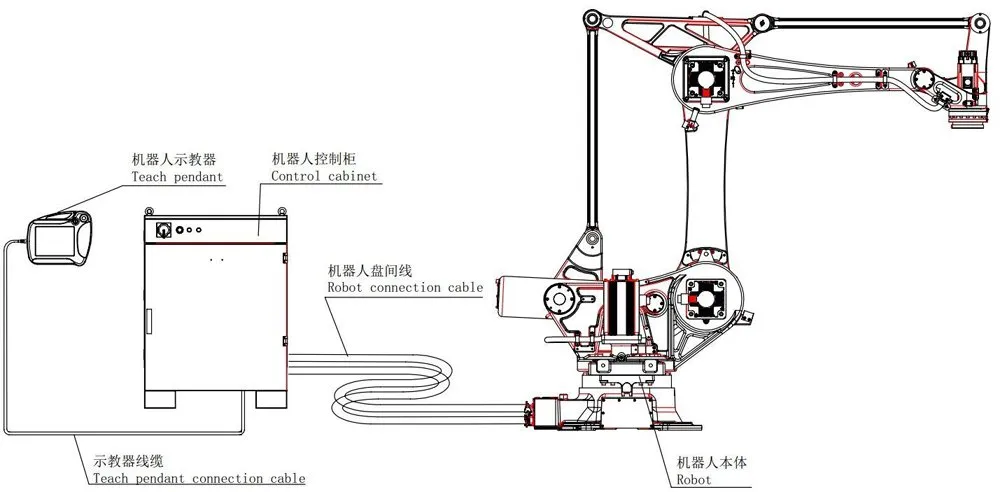
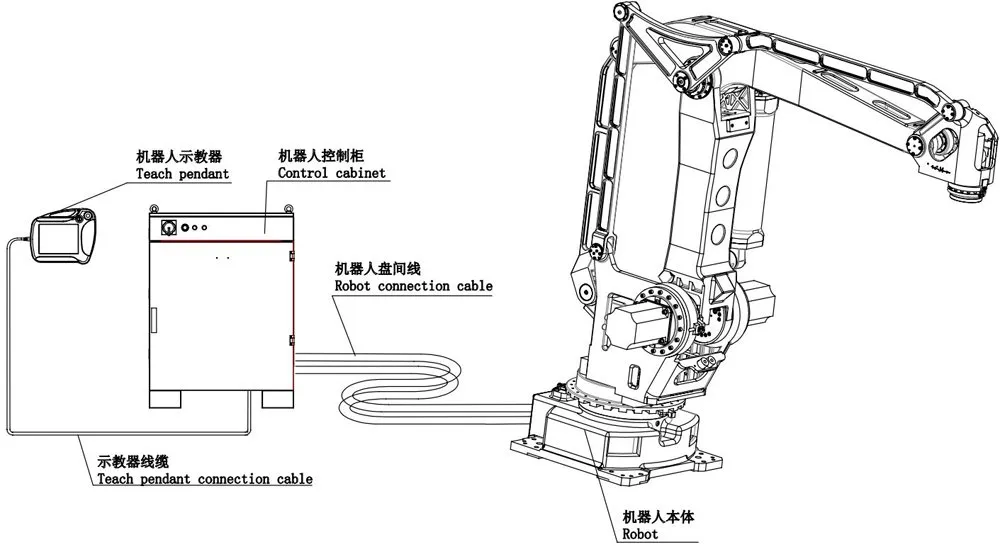
Controller and external axes
| Item | S-cabinet | M-cabinet |
|---|---|---|
| Rated voltage | Single or three-phase AC 220 V ±10 % | Three-phase AC 380 V ±10 % |
| Power capacity | Max. 5 kVA | Max. 8 kVA |
| Digital I/O | 16 in / 16 out standard, expandable to 80 | 16 in / 16 out standard, expandable to 80 |
| Fieldbus | TCP/IP, Modbus TCP, EtherNet/IP, EtherCAT; PROFINET and CANopen/DeviceNet optional | Same |
| IP grade | IP20 or IP54 | IP54 |
| Size (W × D × H) | IP20: 430 × 508 × 224 mm · IP54: 440 × 606 × 229 mm | 700 × 577 × 1045 mm |
| Weight | IP20: 25 kg · IP54: 28 kg | 125 kg |
| External axes | IP20 cabinet: up to 2 · IP54 cabinet: up to 4 (1, 2, 3 or 5 kW motors) | Up to 3 (1, 2, 3, 5 or 5.5 kW motors) |
Frequently asked questions
Which payload do I need for palletizing?
Add the product weight per pick, the gripper weight and any vacuum or clamp hardware, then apply the moment at full reach. A four-case gripper handling 12 kg cases is already at 60 kg of product before the gripper; that is why palletizing robots start where general handling robots stop.
Why four axes instead of six?
A palletizing robot keeps the gripper level, so the fourth axis is all the wrist needs. Fewer axes means more payload and reach for the same mass, and a simpler, cheaper machine. Choose six axes only when the product must be tilted or oriented in more than one plane.
How high can it stack?
Stack height follows from the reach, the mounting height and the J2/J3 envelope — the four-axis models have a defined J2+J3 range that determines the vertical working window. Send the pallet pattern and the maximum stack height and we check it against the envelope.
Do you supply grippers?
Yes — vacuum, clamp, fork and combination grippers sourced in China and quoted with the robot, together with the pallet dispenser, conveyor interface, slip-sheet handling and cell control if they are in scope.
Can one robot serve two lines?
Often yes, with a robot placed between two infeeds and two pallet stations. Whether it holds the rate is a cycle-time question — send the cases per minute per line and the pallet pattern.
Request a quote Send the product data, the rate and the pallet pattern — we return a model and a cycle-time check.