
Equipping a knock-down assembly plant
A new SKD or CKD plant is not bought in one piece, and it should not be quoted in one piece either. What arrives at your gate — painted bodies, welded bodies or panels — decides which shops you need, and the equipment list follows from that single decision. We plan the phases, draw the layout so the later ones drop in without moving what you already bought, and supply welding, conveying and general assembly as one scope or any part of it. SKD means Semi Knocked Down — painted bodies in, assembly only. CKD means Completely Knocked Down — panels in, welded and later painted in your plant.
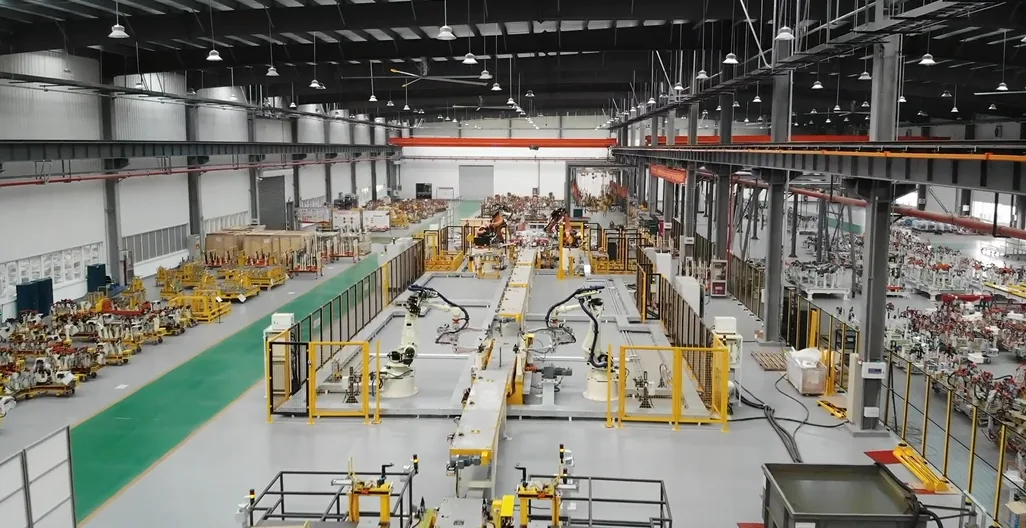
Four phases, in the order plants actually buy them
| Phase | What changes at the gate | What you buy |
|---|---|---|
| Phase 1 — SKD | Semi Knocked Down: painted bodies arrive, the plant assembles. | Trim, chassis and final lines, sub-assembly benches, fluid filling, electrical test, water test, roller test. No welding, no painting. |
| Phase 2 — CKD assembly | Completely Knocked Down: body panels and parts arrive; the plant welds the body. | Add the body shop: floor and underbody line, main framing, body-side, closures, plus the conveying between them and a measuring station. |
| Phase 3 — local painting | Bodies painted in the plant rather than shipped painted. | Pretreatment and e-coat, sealing booth, spray booths, ovens, paint kitchen, PBS between paint and assembly. |
| Phase 4 — local parts | Stamping or supplier localisation, second model, higher rate. | Sub-assembly welding lines for localised panels, extra buffers, model recognition, and the framing gate changeover for a second model. |
Most plants in Russia, Central Asia, North Africa and the Middle East start at phase 1 and deepen over two to four years as volume and local-content rules require. The mistake that costs money is not starting small — it is laying phase 1 out as though phase 2 will never come.
Minimum viable configuration
| Item | What it covers | In phase 1 |
|---|---|---|
| Assembly line | Trim, chassis and final in one continuous line, slat or friction, with the door line alongside. | Yes |
| Sub-assembly | Powertrain, suspension, cockpit, wheel and tyre benches or short lines feeding the main line. | Yes |
| Marriage | Powertrain and axles to the body — lift table at low rate, AGV or pallet line as volume grows. | Yes |
| Filling and tightening | Brake fluid, coolant, refrigerant, fuel; electric tightening with torque and angle logging at the critical joints. | Yes |
| Test | Electrical test, headlamp aim, wheel alignment, roller or dynamic test bench, water test booth. | Yes |
| Body shop | Floor and underbody, main framing, body-side and closures — added when panels arrive instead of painted bodies. | Phase 2 |
| Paint shop | Pretreatment and e-coat, sealing, spray booths, ovens, paint kitchen. | Phase 3 |
| Conveying between shops | Skid conveyor, EMS, painted-body store between paint and assembly. | With phase 2–3 |
Overseas delivery is not new to this chain
The builder has delivered in three countries outside China, among them a knock-down assembly line in Algeria — chassis-line EMS, trim and final slat conveyors, water-test room and filling equipment — and a body shop for a plant in South Africa. Our own three body-shop projects went to car plants in Russia, with the export documents, packing, freight and the people on site organised by us.
The lines and tooling are built by our manufacturing partner in Wuhu — who builds it, and what its plant holds →
What we ask for before planning
- The models you intend to assemble, their volumes per year, and what arrives at the gate in each phase.
- The building: area, column pitch, clear height, floor loading, crane capacity, supply voltage and frequency, compressed air — or the plot if the building is not built yet.
- Local content and homologation requirements that force a phase earlier than volume would.
- The labour you plan to run per shift, which is what decides how much of the line is automated.
- The month phase 1 has to produce its first car.
A phased concept and a quotation come back within one week of a complete set. Painting equipment, when it reaches phase 3, is quoted from the same house — it is the business this company started in. Painting lines →
Best price on enquiry. We do not publish prices. A body-shop package is priced against your body data, the line rate, the number of models sharing the line and the scope split — those move the figure far more than any list price could. Send the requirement and you get an itemised offer, on EXW, FOB, CIF or DAP terms.
Frequently asked questions
What is the difference between SKD and CKD?
SKD — Semi Knocked Down — means painted bodies arrive and the plant assembles them: no welding, no painting, the smallest investment and the fastest start. CKD — Completely Knocked Down — means panels and parts arrive and the plant welds the body itself, and later paints it. Most plants in these markets start SKD and deepen over two to four years, which is how we plan the equipment.
What is the minimum we can start with?
A single assembly line with sub-assembly benches, a marriage station, filling, tightening and the test equipment — everything in the table above marked Yes. Everything else is a later phase, and the layout is drawn from the start so that the later phases drop in without moving what you have already bought.
Can you equip the whole plant, or only part of it?
Welding, conveying and general assembly we supply as one scope or any part of it, up to 60 JPH. Painting equipment is in the builder’s range as well, and painting lines are our own first business — the two halves of this site meet on exactly this kind of project.
Have you done an overseas plant before?
The builder’s record includes a knock-down assembly line in Algeria — chassis line EMS, trim and final slat conveyors, water-test room and filling equipment — and a body shop for a plant in South Africa. Our own three body-shop projects were delivered to car plants in Russia.
Who does the civil works?
You do, to our foundation and pit drawings. What we need from your side is the building: area, column pitch, clear height, floor loading, crane capacity, supply voltage and frequency, compressed air.
How do we phase the investment?
By deciding what arrives at the gate in each phase — painted bodies, welded bodies, or panels. That single decision sets which shops you need, and the equipment list follows from it rather than the other way round.
Do you train our people?
Our engineers are on site through installation, commissioning and the first production runs, and the training happens there — operators on the stations they will run, maintenance on the equipment they will keep running. Visas and overseas labour arrangements are part of what we organise.
Send a body-shop enquiry Conveying and general assembly in detail