
Retooling an existing line for a new model
A model change does not have to mean a new body shop. Every stand in your shop is surveyed against your own asset codes and comes back marked reuse, rebuild, convert or replace, with the reason attached. Installation and commissioning are priced on each item rather than as one lump, which is what lets the changeover be staged shop by shop around production instead of stopping the line as one. We have delivered this on a Russian plant’s changeover of about 180 welding stands and hanging jigs, including the pneumatic and electrical conversion, the spare-parts lists, the design changes during execution and a later in-plant relocation.
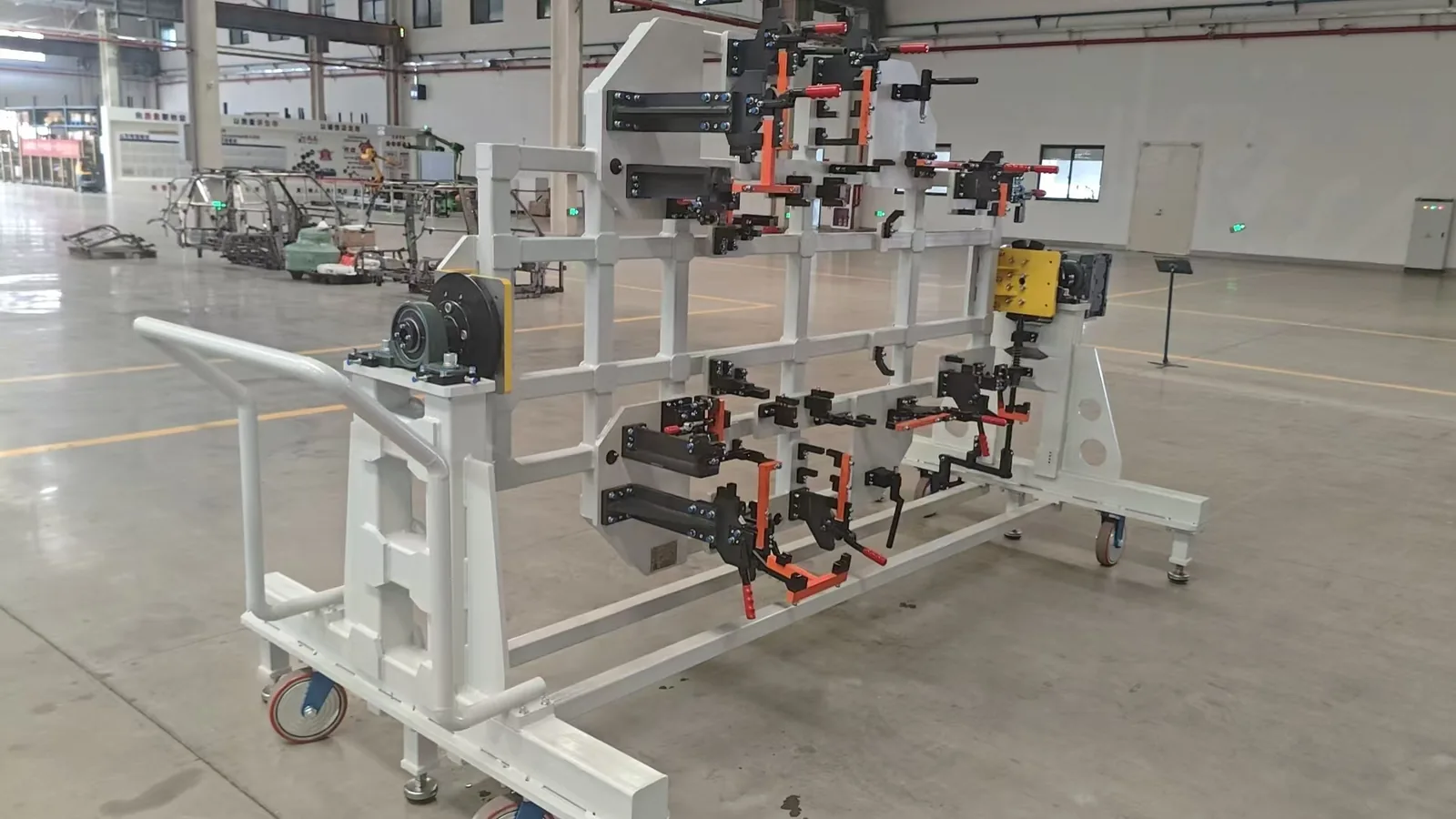
Four verdicts, one per stand
| Verdict | When it applies | What it costs |
|---|---|---|
| Reused as it stands | The panel did not change at this station, or changed inside the clamping envelope. | No cost beyond checking and re-certifying the stand. |
| Rebuilt on the existing frame | The frame, base and clamps stay; locators, NC blocks and pins are new to the new panel. | A fraction of a new stand, and no new floor space. |
| Converted to pneumatic and electrical control | The stand is mechanically fine but clamping is manual and there is no sequencing or safety circuit. | A jig-box conversion: valve island, clamp sequencing, two-hand start, safety circuit, HMI. |
| Replaced | The sub-assembly changed enough that the old geometry cannot be recovered. | A new stand, quoted like any other station. |
The value of the exercise is in how many stands come back “reuse” or “rebuild”. That number is what decides the budget, and it is why the survey comes before the quotation rather than after it.
How a changeover runs
| Step | What happens |
|---|---|
| Survey | Every stand in the shop is listed against the plant’s own asset codes, with photographs and the current state. |
| Reuse, rebuild or new | Each stand gets one of three verdicts and a reason: reused as it stands, rebuilt on the existing frame with new locators, or replaced. |
| Control conversion | Manual clamping converted to pneumatic and electrical control on a jig-box scheme, so the stand gains clamp sequencing and a safety circuit without a new frame. |
| Per-item pricing | Installation and commissioning are priced on each item, not as one lump — that is what lets the plant stage the changeover shop by shop instead of stopping the whole line. |
| Staged shutdown | The changeover is sequenced around production: which stands go down in which window, and what the shop runs on meanwhile. |
| Spare parts | Mechanical and electrical spare-parts lists are delivered with the project, not quoted afterwards. |
| Design changes | Late panel changes are normal on a model change; they are quoted as they arise, item by item, against the same asset codes. |
| Relocation | Moving a line inside the plant, or to another plant, with the same documentation — we have done it after hand-over. |
Why per-item pricing matters more than the unit price
A retooling quotation that is one number tells your plant nothing it can act on. Priced per item, against your asset codes, the same document works for four departments at once: engineering argues with the verdicts, production plans the shutdown windows, finance books the assets, and maintenance stocks the spares. That is the format we have delivered, and it is the format you get.
What we ask for before the survey
- The current station list with your asset codes, and photographs of the stands if you have them.
- Old and new panel data — 3D and the joining information — so the geometry can be compared station by station.
- The rate the shop has to hold after the change, and whether the old model keeps running alongside the new one.
- Your shutdown windows: how many days, how often, and what must keep running meanwhile.
- Plant standards for pneumatics, electrics and safety, if they exist.
A concept and a quotation come back within one week of a complete set. Where a physical survey is needed first, we come to the plant.
What this looked like in practice
- BIW tooling package for an electric model — 65 fixture sets, 29 stations — Russia, 2024.
- A second model at the same plant — 54 fixture sets, 20 stations — Russia, 2026.
- Body-shop retooling for a model change — about 180 welding stands — Russia, 2025.
Quantities counted from the quotations and contract appendices. Customer names, contract values and locations below country level are not published. All three, in full →
Best price on enquiry. We do not publish prices. A body-shop package is priced against your body data, the line rate, the number of models sharing the line and the scope split — those move the figure far more than any list price could. Send the requirement and you get an itemised offer, on EXW, FOB, CIF or DAP terms.
Frequently asked questions
How do you decide what can be reused?
By surveying every stand in the shop against your own asset register, with photographs and the current state, then comparing the old and new panels station by station. Each stand comes back with one of four verdicts and the reason for it, so your engineering department can argue with the verdict rather than with a lump sum.
Why price installation and commissioning per item?
Because that is what lets you stage the changeover. If installation is one lump for the whole shop, the shop has to stop as one. Priced per stand, you can take down a sub-assembly area in one shutdown window and the main line in another. We quoted a retooling project of about 180 stands this way, each with its own installation and commissioning line.
What is a jig-box conversion?
Fitting an existing manual stand with a pneumatic valve island and a small control box: the clamps gain a sequence, the operator gains a two-hand start, and the station gains a safety circuit and an HMI — without replacing the frame. It is the cheapest way to lift an old shop’s cycle time and safety level at the same time.
Can you work to our asset codes?
Yes, and we prefer to. On the retooling project we delivered, every line of the contract appendix carried the plant’s own asset code, which is what let their finance and maintenance departments accept the package without re-keying it.
What happens to panel changes during execution?
They are normal on a model change. We quote them as they arise, item by item, against the same asset codes — not as a renegotiation at the end. That project ran through several design-change packages that way.
Can you move a line rather than change it?
Yes. We have relocated a line inside a plant after hand-over, with the same documentation set — survey, disassembly, marking, re-installation and re-commissioning.
How long does a changeover take?
It depends on how much is rebuilt rather than replaced, and on your shutdown windows, not on our workshop. Renovation projects in the builder’s own records have run as short as two months from contract to installation. The honest planning question is when your panel data freezes.
Do you supply spare parts?
Mechanical and electrical spare-parts lists are delivered with the project rather than quoted afterwards, so your maintenance department can stock before the line runs, not after it stops.