
Conveying systems and general assembly
What carries the body between stations and through the shops, and the lines that turn a painted body into a car: roller bed and skid, friction, EMS, slat, power-and-free, AGV and painted-body storage, with trim, chassis, final, door and sub-assembly lines, marriage, filling, tightening and test equipment. The type is chosen from the rate, the building and the level changes, with material-flow simulation behind the proposal rather than a catalogue page. The builder’s record holds 58 conveying and general-assembly projects, alongside its 66 body-shop lines.
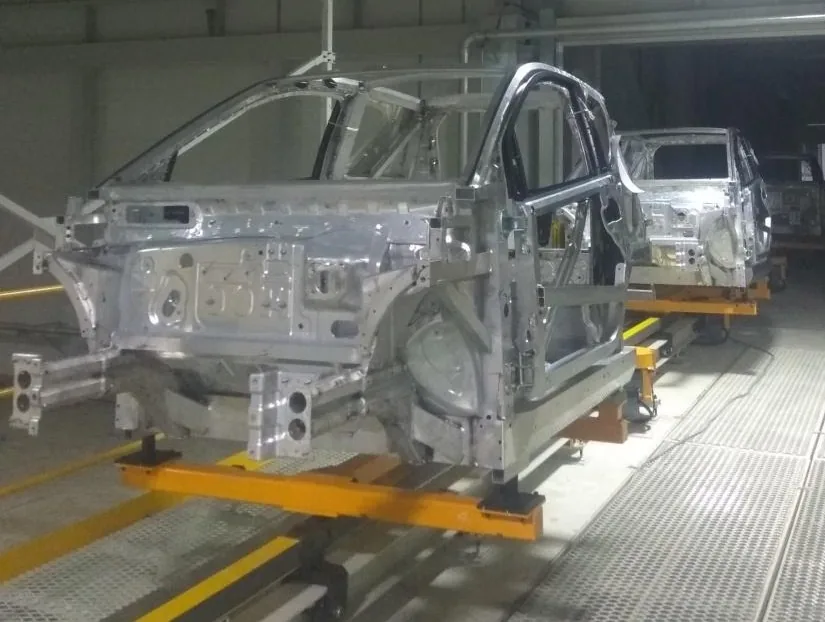
Conveying equipment
| Type | Where it is used | What it gives you |
|---|---|---|
| Roller bed and skid | BIW welding shop, paint shop, general-assembly PBS storage | The mainstream way to move a body: fast takt, high positioning accuracy, the skid stays with the body through welding and painting. |
| Friction trolley and floor friction line | General-assembly chassis line, PBS storage | Smooth and quiet, suited to long continuous runs and to accumulation. |
| EMS — Electrified Monorail System | Between shops, over head, in and out of buffers | Individually driven overhead carriers on a monorail; each carrier is addressed on its own, which is what makes buffering and sequencing possible. |
| Slat conveyor | Trim line, final assembly, water test, heavy frames | Steel or stainless slats, walkable, up to heavy loads — the chain slat line for construction machinery runs to 60 t. |
| Power and free overhead conveyor | Chassis line, sub-assembly, buffer storage | Accumulating overhead line where stations need to be decoupled from each other. |
| AGV and RGV | Powertrain marriage, battery loading, flexible routes | Where the route has to change with the model, or where a pit and a fixed line are not wanted. |
| PBS — Painted Body Store | Between paint and general assembly | Storage and re-sequencing of painted bodies so the assembly line sees the model mix it wants. |
| Lifters, turntables and transfer cars | Level changes, shop-to-shop transfer, line ends | Scissor and chain lifters, turntables and rail transfer cars linking lines at different heights. |
General assembly, line by line
| Line | What happens on it |
|---|---|
| Trim line | Harness, cockpit module, glass bonding, interior trim, door removal and re-fit. |
| Chassis line | Powertrain and axle marriage, suspension, exhaust, brake lines, tightening stations. |
| Final line | Seats, wheels, fluids filling, bumpers, battery, badges. |
| Door line | Doors off the body, trimmed in parallel, re-fitted before final. |
| Sub-assembly lines | Powertrain, front and rear suspension, cockpit (CCB), tyre and wheel, battery pack. |
| Test and rectification | Electrical test, roller or dynamic test bench, water test booth, wheel alignment, headlamp aim, repair bay. |
Equipment on the assembly line
| Equipment | What it does |
|---|---|
| Assist manipulators | Seats, tyres, spare wheel, battery, cockpit module, doors on and off — balanced arms and powered manipulators that take the load off the operator without taking the judgement away. |
| Tightening systems | Electric tightening spindles with torque and angle monitoring at the safety-critical joints, with the results logged against the body number. |
| Filling equipment | Brake fluid, coolant, refrigerant, fuel and screen wash, with vacuum filling where the circuit demands it. |
| Marriage station | Powertrain and axles lifted to the body on a pallet, an AGV or a lift table, with guided positioning. |
| Test equipment | Electrical test, roller or dynamic test bench, headlamp aim, wheel alignment, water test booth. |
| Line control and traceability | Body number recognition, station interlocks, ANDON, production counting and error-proofing on the critical operations. |
The flow is simulated before it is bought
A conveying system is bought once and lived with for fifteen years, and the mistakes are not in the hardware — they are in the buffer that turned out to be two bodies too small, or the level change that forced a second lifter. Layout and material flow are modelled in Plant Simulation, the stations in Process Designer and Process Simulate, and the results come with the concept, before the quotation is accepted. The engineering chain →
What we ask for before quoting
- Building drawing: available area, column pitch, clear height, floor loading, pits, and the crane capacity you have.
- Rate in JPH, shift pattern, the model mix and any phase-two capacity the system must reach later.
- Body weight and dimensions per model, and the skid or carrier you already use if there is one.
- What exists today and where the new section has to hand over to it — mechanically, in control and in safety.
- Supply voltage and frequency, compressed air, and the plant standards for electrics and safety.
A concept and a quotation come back within one week of a complete set.
Best price on enquiry. We do not publish prices. A body-shop package is priced against your body data, the line rate, the number of models sharing the line and the scope split — those move the figure far more than any list price could. Send the requirement and you get an itemised offer, on EXW, FOB, CIF or DAP terms.
Frequently asked questions
Do you supply conveying without the welding line?
Yes. Conveying and general assembly are a scope of their own — the partner has delivered 58 conveying and general-assembly projects, more than half as many again as its body-shop count, and several of them were extensions or retrofits inside plants that already ran.
Which conveying type should we use?
It follows the rate, the shop and the level changes. Roller bed and skid for a body shop and a paint shop; friction or slat for a long assembly line; EMS where bodies must be buffered and re-sequenced; AGV where the route has to change with the model. We propose the type with the layout and the material-flow simulation behind it, not from a catalogue.
Can you simulate the flow before we commit?
Yes — Plant Simulation for material flow, buffer sizing and JPH verification, and Process Simulate for the station-level reach and cycle. The results come with the concept, before the quotation is accepted.
Can you connect to an existing line?
That is the normal case in these markets. The interface — mechanical, control and safety — is surveyed on site before design, and the new section is built to hand over to the old one at a defined point.
Do you do the general-assembly lines too?
Trim, chassis, final, door and sub-assembly lines, marriage, filling, tightening and test equipment, and the PBS between paint and assembly. It is the same engineering chain as the body shop and often the same project.
What rate can the assembly line run?
Up to the same 60 JPH ceiling we take for welding. Most knock-down plants in these markets start far below it, and the useful conversation is which phase you are buying, not the maximum.